
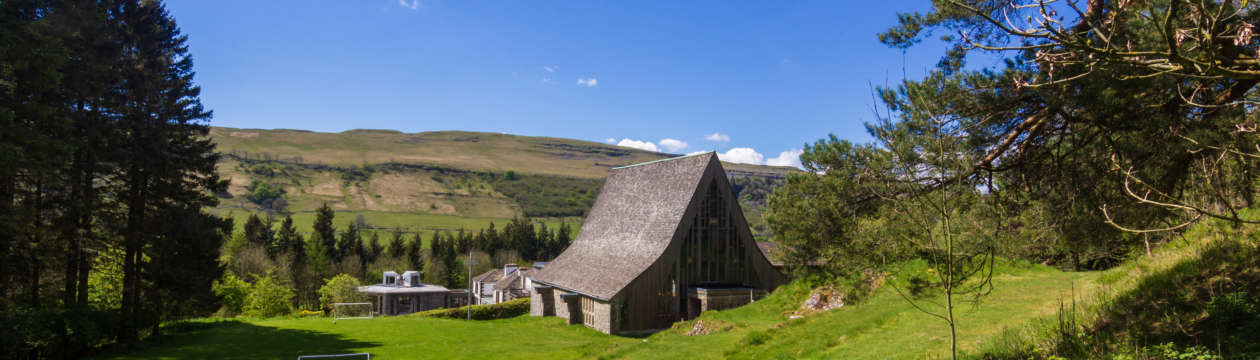
Scargill House was around long before it became a Christian centre as it is today.
The Scargill Estate was created in the 18th century, and then sold in 1900 to a wealthy Halifax mill owner for use as a shooting lodge and a place for entertaining. He never lived at Scargill, and after his death in 1920 his eldest son extensively remodelled and refurbished the house, again as a focal point for sporting weekends, but he did not come to live there until the death of his wife in 1933.
When he died in 1942, the estate was bequeathed to his three sons, two of whom died in World War II. When the surviving son came home from war, he returned to find a neglected estate. To cover the death duties, he sold Scargill to a textile company, which the family still controlled, and set about reviving the estate.
Extensive works were undertaken: the house was connected to the National Grid, central heating was installed, the gardens were restored, and the cottages were built. Scargill House became home to this surviving son and his family; however, it was put up for sale in 1957 because of losses incurred by the mill.
Becoming a Christian centre
In 1959 a group of Anglicans from Manchester (led by Revd H Frankham and the Right Rev Donald Coggan, Bishop of Bradford), inspired by Lee Abbey in Devon, set out to find a suitable property to base a similar community in the North. Scargill Estate was bought with money from thousands of donors across the country.
A Christian community was established with the aim of renewing the church through the offering of hospitality, teaching and recreation. Work soon began on a new chapel, designed by George Pace of York, which opened in 1961. Dormitory blocks and lounges were quickly added and for almost 50 years Scargill House was a popular draw for Christians across Britain, welcoming up to 100,000 people.
Closure and an appeal
In July 2008, after running for some time at a deficit, Scargill House closed and the community disbanded. In response to the news there were over 200 comments on a Church Times blog post, and ‘save Scargill’ pages appeared on Facebook. The Save Scargill Action Group was set up with the hope of finding an alternative to the sale, or raising money to buy the house.
The first supporters’ meeting in Skipton was told that £85,000 had already been pledged, but despite their efforts Scargill House was put on the market for £2.5 million amid fears it could fall into the hands of commercial developers.
The action group joined forces with representatives of Lee Abbey and Bradford Diocese to form a Steering Group chaired by Bishop John Finney, which negotiated the purchase of the house and later handed over to the newly formed Scargill Movement Trust, chaired by the Bishop of Bolton, the Rt Revd Chris Edmondson, a former warden of Lee Abbey and a Scargill partner for more than 25 years.
Resurrection
After the ‘old’ Scargill House was forced to close in 2008, a new Scargill Movement, with new trustees, was registered as a charity in February 2009. In March, they purchased the house and estate in order to continue to operate a Christian retreat and conference centre there. Donations from supporters, plus a loan from the Lee Abbey Movement, enabled the purchase.
In the summer of 2009, Scargill House was truly resurrected. New life began to bloom there as people were appointed to look after the new Scargill Movement’s physical and spiritual development, and the residential community began to be established.
Scargill Council grew, patrons were appointed, and the Archbishop of York became our president. Our exciting development plans have been granted planning permission, and our doors have been open for guests and our programme of events since 2010.
The involvement of Adrian and Bridget Plass in the early days of community life has ensured that laughter, vulnerability and honesty have been key ingredients of the journey they both still contribute regularly to our programme.
This year we have been blessed to be able to celebrate not only 10 years since the resurrection of Scargill House and it’s Community, but also 60 years of Christian ministry in The Dales. To celebrate we went out on tour, had a birthday party at the house and a service of thanksgiving at Bradford Cathedral.
Financially we have been amazed by God’s provision, having paid back the £1.05 million that we borrowed to buy the house, and we have since gone on to make a modest operating profit. We have been able to make many repairs and improvements to our buildings, including converting one wing of the house to en suite bedrooms. In 2013 we replaced our expensive and inefficient oil-powered heating system with a new biomass boiler. In addition to being more effective and much better for the environment, this saves us £15,000 a year in heating costs and also attracts Renewable Heat Incentive payments from the government of £30,000 per year for 20 years. Of course, there remains much still to do and many further improvements that we would like to make to our facilities – if you would like to support us you will find information here.
The support of our Friends, Companions and volunteers has been immeasurable and vital through all of this, along with our Council of Trustees. We feel immensely blessed by God that He continues to send all the people and resources that we need.
We hope very soon to be able to share more news about some of our plans for the future…